On June 12, 2026, SpaceX became a publicly traded company, raising $75 billion and making it the largest initial public offering (IPO) in history. However, it may be only one of several trillion-dollar-valued IPOs to hit the market this year. Anthropic – the AI company behind Claude – filed its IPO confidentially in early June and expects to go public in late 2026 with a value that could top $2 trillion according to media reports. OpenAI – the company behind Chat GPT – filed its own IPO confidentially, reportedly targeting a valuation of $1 trillion or more, although this may now be delayed.
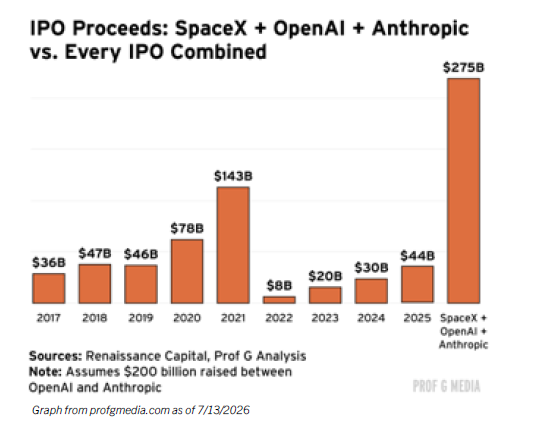
The excitement around these relatively new, innovative companies, along with such extraordinary valuations, may be raising questions for many as to the merits of investing in them. Understanding what an IPO is and how the process works has never been more relevant.
Public Float
One of the most important aspects to understand in an IPO is the public float, which is the portion of shares that is being made available for trading on the open market. The average public float of an IPO typically ranges between 15% and 20% of a company’s total shares outstanding. The SpaceX IPO was unusual in that it offered only 4% to 5% of outstanding shares, far less than the average IPO. Strong demand for the limited share supply fueled substantial early trading gains, but a low initial float is not, by itself, a guarantee of strong performance. The fact that a limited amount of shares is available at the outset, followed by a set schedule of additional shares being potentially offered, points to the risks around liquidity and supply that are unique to IPOs.
Employee Shares and Lock-Up Restrictions
Most of the shares that are not available to the public during an IPO belong to company insiders, such as founders, employees, and private investors who are contractually not allowed to sell their shares for a defined period, called the lock-up period. The terms of these agreements vary from company to company, but they typically do not allow sales for 180 days.
Lock-up periods exist for two reasons: insiders often hold inside information, so preventing early sales is meant to protect public investors from trading with an informational advantage. They also serve to limit supply at a critical time when demand for the stock may be at its peak, which can be supportive of the stock’s price, at least in the short term.
When Does a Stock Enter Major Indexes?
The S&P 500 Index has strict requirements as to when a company can be added to the index including:
- The company’s most recent quarter and the total sum of its last four quarters must show positive earnings;
- The company must be based in the U.S.;
- The unadjusted market cap must be at least $8.2 billion;
- The stock must be traded on a major U.S. exchange for at least 12 months;
- There must be an Investable Weight Factor (IWF) of 0.10, meaning at least 10% of the shares are publicly traded;
- The annual trading volume must be at least as large as the company’s market cap (enough shares of the stock must trade over the course of a year to show that there is real investor interest).
SpaceX does not qualify on several of these measures, and all three of these trillion-dollar IPOs are expected to be locked out of the S&P 500 Index for at least twelve months post-listing.
The Nasdaq 100 Index updated its rules effective May 1, 2026, to help fast-track large new public companies into the index. Companies within the top 40 of the Nasdaq 100 by total market value are now eligible after only fifteen trading days (previously three months) and the prior requirement of a 10% float was removed.
Why Consider Buying an IPO
There can be a lot of hype around IPOs, particularly where the company is large, has been operating as a private company for an extended period, and has a big following among consumers. Hype can be a warning sign, however, as many IPOs perform well in the short term but relatively poorly over the longer term. A study of IPOs from 1900 through 2023 showed that roughly 70% of IPOs underperform — it’s the rare outliers that drag the averages up.
Most companies undergoing an IPO have a relatively short operating history, which itself is a risk since investors cannot assess the financial performance across different economic cycles. Also, the valuation process that companies engage in (with the investment banks that assist in the process) can be fraught with numerous assumptions about the future, including things like the competitive landscape and the growth rate of revenue. The ultimate valuation arrived at can also be heavily influenced by the founders and other key investors who are seeking to capitalize on the IPO process in various ways. Their decisions can be an obvious conflict of interest for the buyer.
With the plethora of risks around the IPO process, it’s fair to say IPOs should be evaluated much like any other equity investment but with key inputs that may not be the same as those for public companies. The various factors noted above concerning the IPO process should also receive careful analysis by seasoned professionals who may be better suited at ignoring the hype that often accompanies certain highly-anticipated IPOs.
As always, the bottom line is caveat emptor.
Firm Definition and Contact Information
Maple Capital Management, Inc. (MCM) is an independent SEC Registered Investment Advisor with offices in Montpelier, Vermont and Atlanta, Georgia. This commentary reflects the views of MCM and should not be considered to be investment or financial advice. MCM does not warranty these views and will not update this communication after the date of publication. Any mention of specific securities is done for illustrative purposes and the securities mentioned may or may not be held in client accounts. No assumption or assurance should be taken that securities mentioned will be safe or profitable investments. Past performance is not indicative of future results.
For further information, please contact David Bosworth at 1-802-229-2838 or at [email protected]. For further information about Maple Capital, including a copy of our informational brochure, please visit our website at www.maplecapital.com.
Disclaimer
This document is a general communication being provided for informational purposes only. It is educational in nature and not designed to be taken as advice or a recommendation for any specific investment product, strategy, plan feature or other purpose in any jurisdiction. This material does not contain sufficient information to support an investment decision and it should not be relied upon by you in evaluating the merits of investing in any securities or products. In addition, users should make an independent assessment of the legal, regulatory, tax, credit, and accounting implications and determine, together with their own financial professional, if any investment mentioned herein is believed to be appropriate to their financial situation and investment profile. Investors should ensure that they obtain all available relevant information before making any investment. It should be noted that investments involve risks, the value of investments and the income from them may fluctuate in accordance with market conditions and taxation agreements and investors may not get back the full amount invested. Both past performance and yields are not reliable indicators of current and future results. All information presented herein is considered to be accurate at the time of production, but no warranty of accuracy is given and no liability in respect of any error or omission is accepted.
Past performance does not guarantee future results. Diversification does not guarantee investment returns and does not eliminate the risk of loss.
www.maplecapital.com | 535 Stone Cutters Way, Montpelier, VT 05602 | Toll Free: 800.255.9946